Showing posts with label career development. Show all posts

Wednesday, July 11, 2012

Great FAST Video on Basic Job Interviews, Patty DeDominic shares

You can bone up on the basics to give yourself confidence before meeting any potential employer or contract opportunity.   
How to Attend a Job Interview - Project Management


How to Attend a Job Interview - Project Management

Want to improve your job interviews? Watch this video to top job interviewing tips.

Project Management - http://www.projectmanager.com/


Patty DeDominic
http://www.dedominic.com/   
Coach to high achievers


Monday, July 9, 2012

Women In Business, Breaking the Glass Ceiling comments by Patty DeDominic

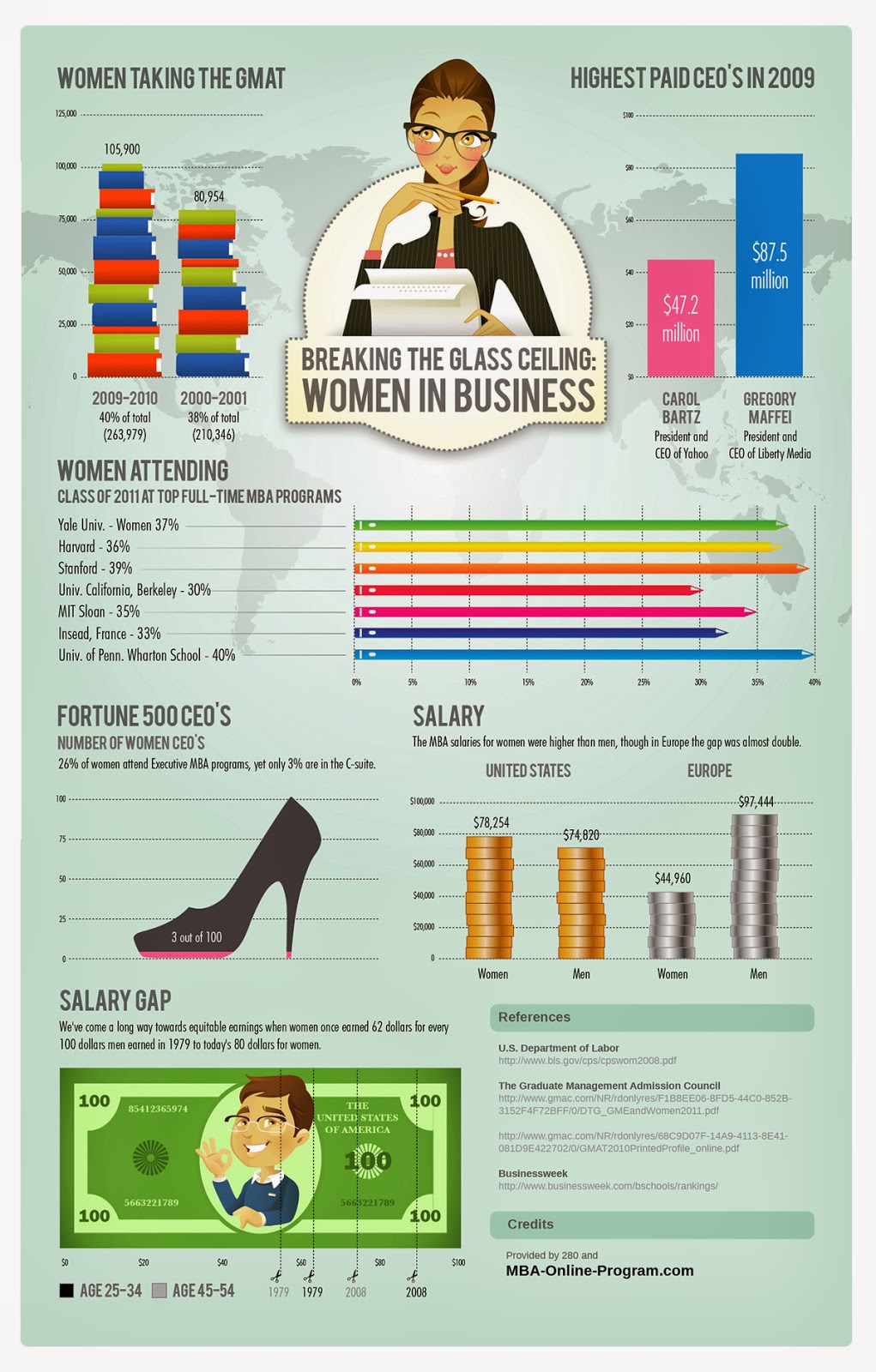
Thanks to Vanja one of the Life Moments Interns for finding this important infographic on women's progress in breaking the glass ceiling.   http://www.lifemomentsforwomen.com/       Women's data shows they made great strides in all areas, but have not yet reached parity.     If you are observing this it is simply interesting.   If you are a high achieving woman, just remember that Ginger Rogers had to do everything that Fred Astair did, but she needed to do it while dancing backwards and in high heels!  

Keep your sense of humor and tredge on!   Surround yourself with the positive and successful people who feed your sould and who understand the power of reciprocity.    You will find that life in business has extraordinary ups and downs as its normal cycles go on.  

Building your personal or employers brand strong reputation as a professional is critical for success in todays chaotic climate.    Your resources will come from many angles and your resourceful creativity will pay off.

Patty DeDominic
Author, Business Coach
Santa Barbara, California


Friday, February 13, 2009

Anne Doyle's Blog Full of Great Leadership Info


From Anne Doyle's site,
Photo is of the Honorable Harriett Weider (left), one of the original BreadWinners and Ann Doyle (right)

Friday, February 13, 2009


The economic downward spiral that we are all struggling with has brought women to another historic milestone: for the first time, there are now more women than men employed in the U.S. workforce. As of November, American women were 49.1% of the workforce. With the latest round of job losses -- 80% of which have impacted men, primarily in manufacturing and construction work -- there are no more women carrying the responsibilities of "primary breadwinner" than men. This isn't about women's progress. It's about men's slippage. It's also leading to new conversations -- in millions of homes across the country -- about the "second shift" work related to home and children, of which women are still doing the lion's share.


To listen: click here. http://www.annedoyleleadership.com/Please come and visit my site http://www.annedoyleleadership.com/.
Patty took the photo in Pittsburgh at the International Women's Forum Hall of Fame Awards event. Anne Doyle has a new book which we highly recommend. please visit her site.

Wednesday, February 4, 2009

Rediscovering YOU in a Job Market Crisis


Rediscovering YOU


in a Job Market Crisis


By
Dr. Ellie Corigliano


Using your creative nature to establish a line of work that can be financially sound, can be quite challenging in a culture that promotes “stay within the lines”.


When we go to school, elementary through to graduate school, we are told what to do, what to learn, how to apply it and when we are allowed, or not allowed to use it.


In today’s job crisis, “staying within the lines” is no longer a viable behavior.

Americans are losing jobs that they have been trained to do, that they are comfortable doing, and that promised them a secure future. And let’s face it, most jobs were designed for a behavior of “do what you are told to do and get compensated for it”. The majority of Americans are trained to follow, not to lead. Which I want to express is OKAY, leading is not for everyone, and they too are losing their jobs, but knowing yourself and your abilities is something we can all do.


It is time for laid off Americans, and those "not- laid- off" Americans, to acknowledge themselves in a new light.


I don’t want to pretend to be an expert on this topic, rather I would simply like to share some thoughts on how to uncover your creativity within your network of established skills and use them to discover a world of new possibilities that empower you for success.


When you go through school, or work at a job for a long period of time, your brain creates a neural network of behaviors, memories, skills, responses, and so forth that become very complex and intertwined, and quite difficult to alter once established…..the whole “can’t teach an old dog new tricks” cliché. To disengage from this network will take some effort but the outcome will provide growth, motivation, self-confidence and possibilities.


Begin by finding a quiet space, a pen and paper, or your computer, clear your mind and start listing your work skills. These skills can range from anything that seems trivial like answering phones, to sophisticated skills like computer programming. For example;

Internet Researching
Map making
Typing
Data entry
Microsoft office- Word, Powerpoint, Excel….
Networking
Organizing

Following through
Initiating ideas
Public speaking
Working with numbers
Etc….

Once you have done this, and make it long, list everything you may normally take for granted, make a list of your closest friends and family and list their skills as best you can. Remember, it takes a team to make a better you (prior article). Knowing what your friends/family are able to do can help you create a larger world of possibilities for yourself. The third thing, make a list of the things you enjoy doing, your hobbies, your aspirations, your “time off” activities. Ask for help in making these lists. Others who know you best can see things in you that you may not consider, like being a listener.


Now try to think about a concept I call “Circular Living”, where your daily living is a converging experience of thoughts and actions, where your hobbies, your interests and your visual image of yourself guide your career path so that your income is generated by your life work, and not just a job.


This job crisis in America is an opportunity that can unveil a side of you that has been lost in the fast pace of keeping up.


Take all the listed information and piece together as many scenic puzzles as you can. The more you play with the information, the more you will find you can add to the lists. Have fun with this. This is your time to grow and expand and re-define yourself.

Remember the way of progress is neither swift nor easy, but perseverance, dedication, patience, compassion, courage and confidence will lead you to prosperity.

Ellie Corigliano, Ph.D.
Dr. Corigliano is the founder of Bionysis (Biological Nutritional Systems), which is designed to integrate scientific research with clinical application for targeted nutritional intervention. She works with patients and their medical practitioner in diagnostics through suggested testing complimented with lifestyle consultation for complete health. Dr. Corigliano is also a lecturer at UCSB where she received her Ph.D. in Biochemistry. Additionally, she is a mentor for Women in Science and Engineering (WiSE) where she mentors on women’s issues concerning career pursuits in science. She also mentors on issues of establishing a family and raising children while pursuing a career.
You can meet Dr. C in person at the International Women's Festival in Santa Barbara, California on March 8, 2009 where she is presenting on a panel "So You Want to Live to be 100?"

Sunday, January 25, 2009

The Power of The Internet to Educate and Enrich


--------------------------------------------------------------------------------------
DON'T LIVE IN IGNORANCE

Use the power of the internet to educate yourself and enrich your life.

Ever wondered about something and weren't sure where to go?
Get on the internet and start searching.


The internet has provided an explosion of information dissemination on a scale previously unheard of - and it's growing daily at a phenomenal rate. There is information to be had on virtually any topic. Sometimes you have to be a little persistent and clever with your search, but the rewards are there.

It's a grand "living encyclopedia".

It's painless, it's free, it's fun, and it only requires some of your time. Everyone's got a computer nowadays. Is yours just collecting dust? I'm not advocating that you become an internet junkie, but if you're not using it regularly your missing out on a great resource.

Of course, there's no replacement for formal education and accreditations. But if you just have an arm-chair curiosity, or want to get a leg up, or need help on a fine point, go to the internet. Even on complex professional or technical subjects, I've found internet resources that have been tremendously helpful. You can now even get a formal education or accreditation on the internet; and the trend is growing.

There are many sources who provide informed articles and advice on countless topics - free for the taking. I write articles on Business, Economics, Career, and related subjects on my own blog site, and as guest-author on others.

If you're reading this article, then you already have some sense of the power of the internet.
Use it to full benefit, and you will enrich your life & career.

Naturally, you have to exercise your own discretion in choosing information. Just as with all other human media, there is bad information out there, and there are those who have nefarious motives. A good dose of common sense will guide you past them.

I recently wrote an article in which I suggested that readers obtain a book of quotes by famous people to assist them with their oral and written communications. The internet serves the same purpose - and much more.

You can enrich your mind, improve your vocabulary, and strengthen your performance in all career and life respects by utilizing the resources that the internet has to offer.

I cannot emphasize enough the power that is at your beck and call.

Kids understand this. They embrace technology easily, and use it to advantage. Our foreign friends understand too. They crave knowledge, and often don't have the wealth or resources at hand for traditional education. If they can find a computer somewhere that has internet access, the have the knowledge of the world laid out at their feet. I've found that some of my most avid readers are people of other nations who crave knowledge. Good for them!

I met my wife on the internet. Marrying her was the best decision I've ever made.
Without the internet, we would have never met. We lived 100 miles apart at the time.
We're now into our 5th year of a delightful marriage.
(Administrators note - Congratulations Mr. & Mrs. Walsh!!)

I use the internet daily; both to disseminate and gather information. You should too.
It's the best "self-help guide" ever created. Then there's the added benefit of using the internet to meet up with people like Patty DeDominic, who I mention often and contribute articles to for her site. Without the power of the internet, we probably never would have met; and that would be my great loss. (Admin here again, thank you Al!)

If you've been holding back, don't wait any longer. Jump on the bandwagon.
The internet is by people, for people.

Al Walsh, Owner/Founder, Walsh Enterprises, Business Advisors

awalsh8174@msn.com

Thursday, January 22, 2009

Betsy Berhemer Credaire announces 15th Anniversary of her Successful Executive Search Firm.

Angeles Retained Executive Search Firm

Celebrates 15 Years in Business 1994-2009


Los Angeles, CA (Jan 21, 2009)—Berkhemer Clayton Inc. marks its 15th Year in Business this month. The retained executive search firm handles national searches for client organizations with major operations in the west, by recruiting headquarters executives at the $150K-level and above in corporate communications, public relations, marketing, finance, operations, and human resources management.

Veteran entrepreneurs Betsy Berkhemer-Credaire, president, and Fred Clayton, chief executive officer, launched the firm in January 1994, after both had successful business careers in public relations and finance, respectively.

“Our key to success for 15 years has been the ability to find the needle in the haystack—the top performer who would also be a good cultural fit for the client organization,” says Clayton. “And then we successfully recruit that executive to our client company. We are proud to have played a role in how business is done in the west and in our community.”

“As a retained firm, we work directly for client organizations who engage us to proactively seek out, attract and recruit experienced executives for specific positions,” adds Berkhemer-Credaire. “But the most gratifying thing about being in the retained search business is knowing we have made a positive difference in people’s lives.”

Berkhemer Clayton’s client corporations include Toyota, Mattel, Nike, Amgen, Edison, The Capital Group, Oaktree Capital Management, Edwards Lifesciences, Hilton, The Walt Disney Company, Universal Studios, and more. Higher education clients include the University of Southern California, Caltech, UC Irvine and University of Redlands.

Non-profit clients include the American College of Trust and Estate Counsel (ACTEC), Kaiser Permanente, City of Hope, United Way of Greater Los Angeles, MALDEF, Ability First, Crystal Stairs, Connections for Children, and The California Endowment.

“In this tough economy today, it’s even more important for organizations to seek out top executives who bring critical expertise in communications, marketing and finance,” notes Clayton, who specializes in headquarters positions including finance, operations, and HR. “These functions are essential to the operation and reputation management of every business, especially during a recession.”

Berkhemer Clayton has also developed an industry-leading track record in diversity: 44% of all executives placed have been women; and 36% have been men and women of color. “We incorporate diversity strategies into every search we handle, with proactive efforts to present an inclusive panel of finalists,” explains Clayton.

Throughout these 15 years, the principals of Berkhemer Clayton have been active as volunteer board members for community and non-profit organizations. Clayton has continuously served on the boards of INROADS, which establishes college internships for students of color, and The Paralysis Project of America, which raises funds for spinal cord research.

Berkhemer-Credaire is currently the statewide president of the National Association of Women Business Owners in California; serves on the board of Southern California Leadership Network (SCLN); co-chairs the Women Corporate Directors of Southern California Chapter; and is a member of the California Utilities Diversity Council.

She previously owned one of the largest independent public relations agencies in Los Angeles, which was acquired by Golin/Harris, a global communications firm. Fred Clayton is a former partner at Ward Howell retained executive search, and before that, led the executive search practice for Price Waterhouse in Los Angeles.


Complete information about Berkhemer Clayton is online at www.berkhemerclayton.com

Wednesday, January 21, 2009

Dr. Ellie Corigliano, One Woman's Story: Science, Self Discovery & You


Women, Science, Self Discovery & You

The pursuit of science is a lifetime endeavor toward the pursuit of knowledge.

It is a traveling affair engined by questions, by ideas, by imagination, by “What if’s” in the hopes to one day arrive at a destination where the unraveling of life’s great mysteries are revealed. Sometimes, however, that alone is not enough to stimulate the study of science and requires a more intimate introduction, and perhaps even more so for women.

As a young girl I was exposed to the practice of medicine. My mother and father ran a medical clinic, where my father was the primary physician and my mother; well she did everything else from drawing blood samples to scheduling appointments. My father loved science and medicine and was fascinated with the workings of the human body. He would introduce my siblings and I to medical equipment such as the microscope, the stethoscope, a blood pressure cuff and essentially allowed us to play “Doctor”. Of these technologies, I found the most intriguing to be the microscope. Under the magnifying lens of a microscope, the smallest components of life appeared to be larger than life. It was as though the most unimaginable, magical aspects of life came alive! I was soon enamored with the chemistry of life and found that science became my favorite subject in school.

Meanwhile, a love for the arts had been developing along side my educational pursuits in the form of dance and music. I soon found myself dancing with the Los Angeles Joffrey Ballet. Though I was just a teenager at the time I realized that both of these pursuits enhanced my view of the world and from then on have believed that all things are possible.

In college I had the privilege of having four amazing professors, three men and one woman, that took the time to flatter my questions with discussion and encouraged me to read material beyond the scope of the course textbook. Their direction introduced me to the notion of scientific research. I had been a pre-med student focusing my degree in biochemistry, but in my senior year I decided to pursue a graduate degree in lieu of medical school.

My fascination with medicine, however, continued along side my research and soon I found myself more interested in the application of nutritional biochemistry for disease prevention and disease therapy. My graduate school campus did not house a medical school, and made my interest of nutrition and science challenging. My colleges, my professors, even my friends, were uncertain of my new direction. I realized at that point how valuable it is to have mentors that encourage you, support you and enable you to chase your imagination, your interests.

In the last year of my doctoral studies in biochemistry I began to attend nutritional conferences, take online courses from top Universities (that housed a medical program) and found a place of inspiration. I recently completed my Ph.D. in 2008 and continue to pursue nutritional biochemistry from both a research aspect and an applied aspect. Though challenges are always present, one of life’s greatest gifts is the ability to direct yourself and surround yourself with others who believe in your assertions. As a mother of a teenager, I witness the powerful influence ones environment has on the motivation and commitment to continue and push through the challenges of ones interest.

Women have historically been key contributors to many scientific discoveries, and today many of us turn away from scientific careers, but we are needed in science for our creativity, our relational thinking, our ability to multi-task and our contribution to excellence. I want to encourage women to continue their pursuit of science, their pursuit of family, and their pursuit of happiness by standing up and initiating the restructuring of your environment to enable you and to work with you for your success. All things are possible in the right environment!

Dr. Corigliano will be one of the speakers at the 2009 International Women's Festival, for more information please visit http://www.womensfestivals.org/

Friday, January 16, 2009

Building Skills by Doing, by Patty DeDominic

Today I had a chance to listen to presentations by experts on Crime Prevention and Gangs on the California Central Coast at a meeting of the World President's Organization. The Chief of Police, the Executive Director of the Police Assistance League and the Director of Youth CineMedia, an organization which gives kids opportunities to learn film making shared some of their accomplishments and challenges with about 40 business leaders. Each had an important story to tell and talked about the importance of community getting involved in helping solve local problems and challenges regarding public safety and crime. Most of the remarks today were focused on concerns about gang violence and prevention and each of the professionals invited input and community leaders' support.

The work that committed adults can do to help kids is endless! But there is MAGIC that can happen when adults show interest in kids, particularly those at risk of failing in school or getting into serious trouble. If you care about your own community and want to meet some fabulous new people and help others with their potential, perhaps this is something you want to get involved in.

Learning by Doing As in the age old "on the job training" there is no better way to become proficient and confident at something which could end up as a job or important career step. What are YOU doing to build your own skills utilizing new technologies? Consider getting involved as a volunteer in youth activities..... you'll gain new skills and provide a much needed resource in your community.

One such Youth program is YOUTH CineMedia, whose tag line is "creating change through the lens of today's youth" www.youthcinemedia.org
Located in Santa Barbara, California, this important not for profit is helping kids gain valuable skills and is keeping them stimulated in the process. To be able to edit video is a skill that will lead to creative expression and could lead to a lucrative career. This year several of the kids films will be shown at the Santa Barbara Film Festival.

I encourage all professionals to build their own skills by doing. I also encourage you to consider following in the path of some of America's leading corporations and philanthropies, like AT&T, Young President's Organization and the Women's Fund of Santa Barbara by getting involved with youth programs.

Saturday, January 10, 2009

Mentoring for Managers, Career Development Tools, more from Al Walsh

Financial Statements for Dummies - A Career Development Tool

Don't know how to read Financials?
Paraphrasing the popular “how-to” books, this article is a basic primer on understanding Financial Statements.
It’s scary to me how many business managers can’t read their own company’s Financials. Even some business owners barely understand their own Financials (and, scarily enough, some Finance people too).
Any manager who wants to advance beyond the status of “junior flunkie” should have at least a cursory understanding.
I’m not going to get involved in double-entry accounting and debits & credits. That would just confuse you and it’s unnecessary for this discussion. If you have no idea what I was just talking about, accountants post two entries for every transaction; a debit and a credit. It’s called double-entry accounting. Enough said.
All you accountants out there can now close the article and go away. This is basic stuff.


So here goes:

The two basic Financial Statements are the Balance Sheet and The Income Statement (or P&L).

Let’s talk about the Balance Sheet first:
The Balance Sheet is a reflection of the financial makeup and standing of the company at any point in time - usually at each month-end. It is a roll-up of every transaction the company’s done from day-one to present. It reflects EVERYTHING that’s happened; including Profit or Loss (more on that later).

The Balance Sheet is made up of three broad categories: Assets Liabilities and Net Worth (or Owners’ Equity). The total of Assets always equals the total of Liabilities plus Net Worth. (Assets = Liabilities + Net Worth)

Assets = the things the company owns: Cash, Accounts Receivable, Inventory, Land, Equipment, etc. If you prepay insurance, or some other purchase, you would also post an asset entry here.
Liabilities are the debts of the company: Accounts Payable, Bank Debt, Car Loans, etc. They’re split up between Current Liabilities (the money due within the current fiscal year) and Long-Term Debt (Amounts due beyond the current fiscal year).
Last, we have Net Worth (Owners Equity).
Net Worth contains: Any money invested in the company minus any dividends paid plus the net total of all annual profits (negative for losses) since day one (called Retained Earnings) plus the total of profits (negative for losses) in the current year.

Not too difficult, huh? Now let’s talk about the Income Statement (P&L):
The Income Statement is a reflection of all Revenues and Expenses for the current year; in other words, the company’s profitability. The bottom-line number is Net Profit, which = all Revenues less all Expenses. Remember I said earlier that the Balance Sheet reflects ALL transactions of the company? The Net Profit total of the Income Statement flows to the Balance Sheet as the total of current year profits in the Net Worth section. At each year-end, the Income Statement zeros out to begin a new year. On the Balance Sheet, the current year profit in the Net Worth section transfers to the Retained Earnings total and the current year profit value goes back to zero for the start of a new year. If you’re confused, read this a couple times and you’ll get the hang of it. This is where beginning accounting students start getting glaze-eyed, but it’s not that tough. Just sleep on it.

That basically sums up your two key Financial Statements. There are others, but unless you’re heavily involved in the numbers you don’t have to know those. With an understanding of these two, you can get a decent handle on the company’s status.
I didn’t get into some of the more complex stuff like Capital Purchases vs Expenses, or Depreciation, or some of the hinky accounting transactions, but that’s okay. That’s a set of topics for another day.
If you’re still confused, get your hands on some Financials and go find the categories mentioned in this article. It will come to you.
I hope this helps.

Wednesday, January 7, 2009

Al Walsh on the World - Watch out for that Tiger

Nostradamus Was Right, World-End Is Coming!

Watch out for that tiger!

Nah! Nostradamus made good money selling nonsense to the impressionable, but he makes for good comedy relief leading into my next topic; which is quite serious.
A lot has been written about techniques for business people in the new millennium. I happen to believe that the required skills are largely timeless; being applicable at all times. But perhaps there is one factor that we should pay very close attention to at this particular time.

We’ve been through many economic downturns and survived; including the Great Depression. But I think the one we’re in now deserves special attention. It’s unique because there are financial tidal-forces of monumental size out there that haven’t played out yet. Just consider the multi-trillion, largely-unregulated, highly-speculative derivatives market. A good portion of it is tied to the mortgage mess, and those instruments haven’t been priced down to their true value on balance sheets yet.

Somewhere along the way there’s going to be a day of reckoning, and it’s not going to be pretty.

The actions of the Fed & Treasury to throw “funny-money” (huge quantities of new, unbacked money) at the mess have just frozen it in time. There will come a thaw. What will we have when it comes? The money-throwing might help stem economic deflation, but it will inevitably create huge monetary inflation. We have yet to deal with that monster. And if we can’t stem the economic deflation, we might get the unique “thrill” of having deflation and inflation simultaneously. It’s enough to make one very queasy.

The Wall Street pundits blow sunshine at us because they don’t know what else to do. I can smell their fear. The government just seems to be in a stunned state.

Given the oddity and uniqueness of the situation, it’s difficult for most businesses and individuals to surmise what the impact to them will be. This, of course, leaves everyone in a high state of anxiety.
If you’re not aware enough yet to feel edgy, I highly recommend you start now.

We all want to believe that it will work out okay. Government “talking heads” come out periodically to tell us so. But I don’t think anyone really knows. The banks don’t want to lend to each other for fear of what the “other guy” is holding in his hand. “Will they go under and take me with them”". It’s like a scary game of poker. The banks aren’t loaning out the money they got for their junk mortgage instruments from the Fed because their balance sheets are in jeopardy. The Fed is probably in the best position to know the true nature of the situation, because they bought a lot of the junk. But the Fed isn’t talking. They won’t even say who they gave the money to.

I can’t prove it, but I’ve believed for a long time that the government manipulates the markets during such times through their finance house partners. The “Plunge Protection Team” (The President’s Working Group on Financial Markets) is, after all, quite real and various statements have slipped out of the Fed hinting at such activity. So we are left wondering what is real, and what is smoke & mirrors. Main Street is left holding the bag - with their liquidity cut off and with no good sense of what’s coming.
About six months ago I learned something that made me really frosty. It seems an executive order was put in place to absolve public companies from having to meet full disclosure rules in a national emergency. If the government deems it “necessary” for “national security purposes”, a public company doesn’t have to tell their investors the full truth. Is anybody besides me scared to death at that prospect? I can’t help wondering if it’s being applied now; and to what extent.
In my opinion, we really managed to make a mess of things this time and people have good reason to be concerned.

Which brings me to my subject. Now is a very good time to sharpen your intuitive senses. In the best of times we of the modern world are buried in information. Sorting through it to keep ourselves founded can be daunting. Now we’re faced with challenges that have no precedent, and for which we have no feeling of the potential hazard. Pay attention.
When a farmer in India has a tiger in the neighborhood, he has no trouble keeping his priorities straight. He’s got to feed the family, and there’s endless chores to do, but that tiger is always in the fore-front of his mind. We need to be a lot like that farmer, and use our intuitive senses to help us keep alerted to potential danger.
Since the first humans sat in their caves at night listening to the predators snarling in the moonlight, we’ve been building a strong survival instinct. In our civilized world, that instinct has been dulled. Sometimes it’s difficult to tell the wolves from the sheep. But the instinct is still there if we listen.
There’s a tiger in our neighborhood, and perhaps some wolves too. This is a very good time to heighten our senses and watch for trouble. If it comes, it will probably arrive quickly and in a form we’re not accustomed to. Like that farmer, we have to watch for surprise attacks from the bushes.
Good luck to all of us.

Al Walsh is a regular contributor and has launched his consulting practice. Please enjoy his other posts and comments he is a favorite at The NEW New World of Work.

Monday, January 5, 2009

Teaching the Teacher from Dexter J. Valles

The arbiter of knowledge and skills, the teacher, is a revered figure around the world. In India, the teacher is known as the guru, the wise one who can be trusted to lead the knowledge-blind and shine the light of competence and skills in the darkness of ignorance and incompetence.

Over time it has been realized that the wise one is not necessarily the most skilled teacher. Learning proficiently and transferring the learning just as well is not really as simple as it seems. It takes far more skill to teach than to learn.

The teacher has not only to have a full and wholesome appreciation of the subject but also know how best to transfer this in its entirety in a useful manner to the learner considering the learning styles and needs of each individual learner.

Whilst studies have been popularized concerning learning styles, and suitable adaptation of knowledge transference has been undertaken to match the varied learning styles of participants, the newer platform of transference has to do with the multiple intelligences that seem to be far more effective in reaching across to the learner.

The theory of multiple intelligences was developed in 1983 by Dr. Howard Gardner, professor of education at Harvard University. It suggests that the traditional notion of intelligence, based on IQ testing, is far too limited. Instead, Dr. Gardner proposes several different intelligences to account for a broader range of human potential in children and adults. These intelligences are:

• Linguistic intelligence (word smart)
• Logical-mathematical intelligence (number/reasoning smart)
• Spatial intelligence (picture smart)
• Bodily-kinesthetic intelligence (body smart)
• Musical intelligence (music smart)
• Interpersonal intelligence (people smart)
• Intrapersonal intelligence (self smart)
• Naturalist intelligence (nature smart)

How does this affect us learning facilitators and trainers and our participants?

The theory of multiple intelligences has strong implications for adult learning and development. Many adults and young professionals seeking to make their mark in life often find themselves in jobs that do not make optimal use of their most highly developed intelligences. For example, the highly bodily-kinesthetic individual may be stuck in a linguistic or logical desk-job like customer care when he or she would be much happier in a job where they could move around, such as in front-line sales.

The theory of multiple intelligences gives adults a whole new way to look at their lives, examining potentials that they left behind in their childhood (such as a love for art or drama) but now have the opportunity to develop through courses, hobbies, or other programs of self-development.

This is another way of chasing away the boredom with the routine or the mundane work one becomes habituated to accept and live with, lowering the levels of enthusiasm, responsiveness and creativity – some of the essential ingredients for success in these competitive times.

What we must recognize is that these multiple intelligences offer choices to (a) trainers/teachers/learning & development facilitators to use varied methods and practices of transferring and processing learning deliverables and to (b) participants to acquire and learn varied methods of addressing work itself, using creative methods to address work issues through the favoured and more developed intelligences

Let’s look at the eight intelligences and how training or learning methods can be matched against them.

Linguistic intelligence (word smart): Reference reading material, reference books, well scripted program handbooks.

Logical-mathematical intelligence (number/reasoning smart) Case studies, problem solving models & techniques, inventory/ questionnaire/ response form/ instrument evaluation & analysis.

Spatial intelligence (picture smart): Use of graphs, charts, pictures and diagrams.

Bodily-kinesthetic intelligence (body smart): Role plays, projects, structured training games/activities.


Musical intelligence (music smart): Music with learning deliverable lyrics. Participants create musical learning summaries using popular tunes, leveraging nursery rhymes to advanced learning songs & anthems.

Interpersonal intelligence (people smart): Team exercises that need the identification and use of the varied resources of team members.

Intrapersonal intelligence (self smart): Presentations by participants on processed learning, role-reversals. Participants study and deliver (teach) selected modules in the program itself, participants are asked to create learning models/modules

Naturalist intelligence (nature smart): Learning from real world experiences, interpretations and guiding principles that emerge from such experiences.

Dr. Howard Gardner says that other than areas of developed expertise, most of us react or process and infer learning outcomes in all other areas in the manner we used to do as 5-year-old kids – the earliest levels of cognitive intelligence.

Implications of this are as follows for trainers/facilitators/teachers and our corporate participants:

1. As trainers/teachers/facilitators we need to be experts at what we teach else we are simply transferring our own 5-year-old childish reasoning and logic to the participants, who receive it believing it is the word of the expert. The snowballing consequences are nightmarish!

2. To be experts, demands more than average attention and learning in the area of study.

3. Extensive reading (to replace extensive research and study) is the minimal effort one has to undertake to raise the levels of personal awareness, knowledge/content and competence/understanding.

4. Participants are unlikely to react in the ‘expected’ manner in either receiving, processing or understanding the learning deliverables, as they are most likely to be at a level of ‘non-expert’ in these areas and therefore would have learning conclusions matching their own 5-year-old level of logic and belief.

Concluding remarks

This exercise leads us to some interesting conclusions in the training-learning process:

a. Content transference is easily possible at an adult learning level. Summarising received content at the end of the program is not an indication of learning or understanding as pointed out by Dr. Gardner.
b. Understanding can only be ascertained when participants apply the learning in simulated real world experiences that are necessarily different from the experience created when delivering the concept. For example, participants can offer each other their own past experiences and ask others how they would use the learning to have handled the situation, or offer their own new approaches to the old
c. Training videos, role plays, case study experiments, training exercises, need to be processed with ‘understanding’ in mind – not a simple analysis of what happened in the experiment or video or exercise, which is what participants tend to explain, but how this learning can be applied at work/back in real life.
d. Similarly hoping that the video/exercise or experiment is ‘self-explanatory’ is not constructive as the learning derived by participants is likely to be unprocessed content management and learning summaries are derived from the 5-year-old child-like ‘theories of life’. The ‘expert’ must anchor the learning rather than leave loose ends to be automatically tied.
e. Understanding can be investigated only by moving from basic questions like what, why, how to the more advance ‘aesthetic’ level questioning skills/questions that ask participants to offer personally processed input that has direct bearing on their work practices or behavior.
f. This points to program design and delivery process. Program designs which are packed almost like a school time table leave very little processing and understanding time. The program flow is often ‘impaired’ by handling lack of understanding or processing by participants and therefore participants learn to respond by cleverly managing the showcasing of content to represent learning and understanding, in order to release the program flow and time which tends to be the casualty, in a concept-crowded program.
g. The facilitator has to be equipped to deal with the following learning hurdles which participants will unconsciously throw up.

■Misconceptions: Based on their past experiences, pet theories and assumptions
■Rigid algorithms/formulas: Formed from their earlier explanations of how the world works; input to output formulas that worked or seemed to work; expert opinions of others they consider experts, information in magazines/MIS data (tabulated and charted data tends to overwhelm the thinking and understanding process).
■Stereotyping and world views held by participants to diagnose and judge the rest of the world , in order to make decisions, are usually based on earlier formed assumptions and perceptions which without confrontation or validity checks, often script the guide book of their current life.

Dexter J Valles, business and life trainer renowned for his programs under the “At the Steering Wheel of Life” and “Winning Edge” banners, is CEO of VALMAR INTERNATIONAL, a Mumbai-based management consultancy. Contact him at www.valmarinternational.com or http://valmar.page.tl

As seen on tickled by Life on Jan. 5, 2009

Saturday, January 3, 2009

SALLY in the Middle East, January 3, 2009

Here's more about our friend Sally, American living in Kuwait:


I have my Bachelor's of Science degree with a strong specialty from a prestigous University in the USA.


My home town is San Francisco, California so I am accustomed to a great climate, smart people and lots of opportunities. I also have my MBA in Accounting and Finance from an east coast Graduate school.

Just today, I have sent my resume to a boutique PE firm based in San Francisco in which the Manager is presently in China. It is for an Analyst position in which I would be able to fulfill this position virtually while here in Egypt. This Manager, whom I had met through LinkedIN, is going to put in for me to get this position along with his recommendation. I will let you know if I do end up getting this position which would be optimal.

Sally's latest experiences using Linked In and working Virtually in the middle east

Thursday, January 1, 2009

BioSciences is Growing Exponentially Fredric Abramson on Leadership


Dr. Fredric Abramson
CEO & Educator on Leadership


We Asked Dr. Abramson about TRUE Leadership


I'm struck by what I see as confusion between an individual taking action and someone taking action AND pointing the way for others.
A leader is out in front. A leader knows that bullets come from two directions: in front and from the back.
A leader realizes it is not about him/her but about the ability and opportunity to get others to act in a coherent, cohesive action.
A leader sees chaos and finds paths to sanity.
A leader is in the middle of playing the game, and doesn't ask anyone to do what he/she wouldn't do.A leader sees "a" future, commits to move towards that future, and works to enlist others to join him/her in reaching that future.
A leader knows that perfection is an illusion, and adjusts as the world changes.
A leader realizes that competition can do things better, and that beating the competition is to be even better. A leader doesn't have to con people with platitudes and clever sayings.
Just some personal thoughts. I agree that we have to retake control of our country.
I also believe we have to retake control of our own lives.
Do you really believe that other people know what's best for you?
If you don't, why do you follow their advice blindly?


About Fredric Abramson PhD., S.M., Esq.
Founder and CEO of Alpha Genics


AlphaGenics was formed to commercialize genomics science with scientifically-based products aimed at the consumer lifestyle market. Consumer lifestyle includes physical appearance, mental performance, dating, and identity security. We leverage the extraordinary technological advances taking place in biotechnology, computers and telecommunications that now enable businesses to develop and deliver focused, personalized products wrapped around a person’s normal genes.

His education includes University of Michigan (Ph.D., Human Genetics), MIT (Master of Science in Management; Alfred P. Sloan Fellow), University of Rochester (M.S. Biology), University of Pennsylvania (A.B. Mathematical Biology) and American University (J.D., 1987), and is admitted to the United States patent bar and the bar of the United States Supreme Court.


Wednesday, December 31, 2008

Are YOU a True Leader? by Al Walsh

Are You a True Leader, or Just An Acronym-Tosser?
Getting with the Program. Don't Stick you head in the sand!

There are many good business tools in use today for growing and improving businesses:
ERP, Lean, TQM, WCM, Six-Sigma, JIT, ISO, etc.
Some have been around for a long time, and some are relatively new.
These tools all address goals that business people have been trying to achieve since time immemorial. The major difference now is that information technology has improved to the point where it’s possible to develop business intelligence and process control on a scale previously unthinkable.

These tools & practices are becoming commonplace in the business world.

If you think you’re immune, you’re probably in for a rude surprise; even if you’re a small company. Shrinkage of the “supply-chain” world is forcing companies at all levels to implement them. You might get by “under the radar” for awhile as a small business, but eventually your customers are probably going to force your compliance if you want to keep their business. Likewise, you will be forced to impose these conditions on your vendors. Anyway, why you wouldn’t want to use every tool at hand to improve your business is beyond my comprehension. Certainly you want to use them wisely, and improper use can actually be destructive, but such investments can garner huge benefits.

So, that brings us to the question of what type of leader you are:
We’ve all experienced them - the people who throw acronyms around freely to impress, without having any comprehension of what they mean. Are you one of them?
We’ve also encountered those who summarily reject all such resources because they’re “too expensive” or “too complex for our business”, or for some other blanket reason.
I suppose there are also a few sheltered people out there who have no idea what I’m talking about (Good luck to you!).
Do you comprehend the myriad of good tools available to improve your business, or is your head firmly implanted in the sand?
If you’re behind the curve, it’s time to “wake up and smell the coffee”. Not only do you want to avoid getting caught napping by your customers, but you’re probably missing out on real fundamental opportunities. I’m a firm believer in exercising constraint in these matters. If you don’t really need a “fancier system”, or if things are working well and “don’t need fixin” - then by all means you should exercise caution. But what about tomorrow - How are you going to get your business to “that next level”?
If you’re just throwing acronyms around, you obviously are conscious on some level that these things have value. Isn’t it time to learn what they’re really about? I’d bet your competition knows. Most likely someone within your own company does, and is going to figure out what a phony you are; if they already haven’t.
If you’ve summarily dismissed all of these tools on some “intuitive grounds”, it’s time to take wake up and take a fresh look.
I mentioned in a previous blog that effective leadership involves taking a forward-looking posture; planning, setting goals, anticipating changes, and always looking for opportunities to grow the business & shine. There are tools & processes out there that are just “itching’ to help. It’s time to take a hard look at them.
For the sake of your business - for the sake of your career - become informed. Those businesses facing possible hard times in the current economy should especially be paying attention to tools that can make your company leaner and meaner. Your competition will!


Al Walsh is a Los Angeles area "Unrepentant Capitalist".
CAREER ROLES:~ CEO - V.P. - CFO - COO - Entrepreneur~ Executive Committee & Board Member~ Partner and Advisor to CEO's, COO's & Boards~ Multi-Disciplined Consultant & Contractor

Friday, December 19, 2008

TAKING YOUR CAREER QUESTIONS

Please ASK the Experts by commenting on this blog...
it's easy and you can ask your under your own name or completely anonymously.

Just click where it says "Comments" and fill in the blanks.
We will give you a response within 24 hours!

Tuesday, December 16, 2008

THINK GROWTH! an article by Kathy Ullrich

Think Growth, Not Self-Preservation
By Kathy Ullrich

“Self-preservation is the worst mistake a CEO can make,” shared StrongMail CEO Sam Cece at the most recent Getting to the Top program at Stanford Graduate School of Business. “The role of the CEO is growth of a business and if the CEO is worried about self-preservation, he cannot be effective at growing the company. Just like the fastest race car drivers on the track, the best CEOs need to go for it. If you make decisions based on keeping your job, you will get crushed.”

The same concept may apply to companies in uncertain economic times. Of course companies may have some belt tightening to shore up resources. Beyond that are the strategic moves that can put a company ahead of competitors as the recession dissipates.

A McKinsey Quarterly article, Preparing for the Next Downturn, shared learnings from the previous recession. The article stated that despite many companies toppling from the top quartile, “Fifteen percent of companies that had not been market leaders prior to the last recession vaulted into these positions during it.” These companies had several common characteristics entering the downturn: balance sheet flexibility through lower debt-to-equity, operating flexibility from reducing costs, and diversified product offerings, including geographic diversity. All these gave the companies strategic flexibility to take advantage of opportunities.

To set the strategy and execute on it, companies need the right talent. For employees of all levels, self-preservation can mean doom. Employees need to think through how their efforts drive revenue, reduce cost or create strategic flexibility for the company.

As Silicon Valley came out of the last tech recession, I was quoted in USA Today. Google had hired Vinton Cerf, a father of the Internet, and the reporter wanted comments on companies’ use of executive recruiters. That was a time of major companies in Silicon Valley – SAP, HP, Microsoft, Yahoo -- hiring numerous executives in building toward business growth strategies. During weaker economic times, many key executives remain in positions rather than face unemployment and are therefore open to a new job for the right opportunity.

I encourage companies to think about not the incremental, but the big move that will propel the company, whether strategic or people changes. In softening markets, once the company has created strategic flexibility, it is the perfect time to take advantage of growth opportunities over other companies worrying about self-preservation.